As part of the CEM certification course I help teach, we look at how channels have unique interaction characteristics that can create strategic advantage. Netflix offers DVD rentals online, with a rental queue. Blockbuster was traditionally a brick-and-mortar location.
Netflix has more titles than your local Blockbuster. You don't have to leave your house to choose your next movie. Or to get it. Sure, there's a delay (but Amazon.com has gotten us used to this ... ).
Netflix as a result has been growing gangbusters, while Blockbuster was feeling the heat. Then they got into the online business. We go through very careful analysis of the site experiences and churn rates for online customers at each firm. Things were looking good for Blockbuster's strategy.
Except that the board, and the stockholders, felt that Blockbuster's investments were just too costly. Profits plummeted while they acted like a growth-obsessed startup instead of the cash cow they had been. CEO? Fired. New CEO has a Southland Corporation background, all retail and supply chain.
Ah, now we come to today.
Netflix, hot on the heels of Blockbuster's new CEO, is actually reeling a bit. But it's because they've lost some growth momentum to Blockbuster's combined online/retail model. Rent online, return to your local store (not all stores are participating.)
The saga continues. Will Blockbuster continue to pick away at Netflix? Or is the new CEO a signal that Blockbuster doesn't want to compete online?
Check out the Netflix earnings story here .
Monday, July 23, 2007


Mashups, no longer cutting edge?
I've actually been lecturing on Mashups lately -- did a gig at the World Bank, and it's part of my Customer Experience Management talks now. My argument is basically this. With AJAX at the front end allowing customers to see and interact with data stores from different sources, and with the enterprise's ability to aggregate, recombine and supplement its own data incrementally, all at low cost, then the only thing keeping a company from letting customers manage their own experiences is ... nothing. Mashups are here. The question is, what kind of access can you give your customers to your data -- crossed with things like Flickr, Google Maps, and so on -- that will build your brand?
If you don't think giving customers this level of control and transparent access to key data is a good idea, feel free to maintain that opinion, whilst your competitors beat the socks off of you in the market. :)
And, hey, here's a great link listing some new mashups. See if you can imagine something similar for your business.
If you don't think giving customers this level of control and transparent access to key data is a good idea, feel free to maintain that opinion, whilst your competitors beat the socks off of you in the market. :)
And, hey, here's a great link listing some new mashups. See if you can imagine something similar for your business.
Thursday, July 19, 2007
Democratic Tag Clouds
This may seem off topic from global CRM issues, but bear with me.
Pollster.com posted an analysis recently of the language used by Democratic candidates in a Spring debate. The analysis was represented as tag clouds. (Janet Harris, a friend of Pollster.com, posted the analysis. I think but I'm not sure that this is the same Janet Harris who founded and runs Upstream Analysis, a consultancy that does media monitoring.) Tag clouds are most often used to represent the relative popularity of words on a given topic by making popular words larger and/or heavier in typeface. Common words such as "the" and "and" can be removed.
In fact, some services don't actually look at the words, but at the way people like you and me tag them. Britney Spears might be the phrase, but "doofus" might be the tag applied to her by some number of people. If you doubt that people would be so rude in tagging content, check out the user tags describing Britney Spears albums on Amazon.com. (When folks like you and me tag things, those tags make up a "folksonomy" -- not a taxonomy.)
Check out Janet's analysis here, and then come back for the global CRM point. [UPDATE: In the interests of bipartisanshipnessicity, here's a link to a Republican debate tag cloud.]
(fingers thrumming on the table)
OK, you back? Interesting, huh?
OK, the idea is this. When determining your value proposition in a given local market for your products and services, you had better get some savvy market intelligence, especially about how your target audiences will value/assess your offering. You can do focus groups, surveys ... and you can actually get prospects and customers to tag your offerings on your home page.
If you look at these tags across cultures, what do you think you'll discover? Will it matter? Will you be able to act on it?
If you doubt that tag clouds, presented to your chief marketing and sales people, won't make an impact, take a look again at Janet's analysis, and pretend you are a campaign strategist for Chris Dodd (Senator from Connecticut, and a decent guy from all accounts, including from personal experience). You want to bet that Senator Dodd has already seen this information?
The trick always is to find out what your market thinks and feels about you. If you can, exploit the power of the Internet to give you that insight: consider tag clouds.
Hey, and here's something cool: a tag cloud for this blog posting:
Pollster.com posted an analysis recently of the language used by Democratic candidates in a Spring debate. The analysis was represented as tag clouds. (Janet Harris, a friend of Pollster.com, posted the analysis. I think but I'm not sure that this is the same Janet Harris who founded and runs Upstream Analysis, a consultancy that does media monitoring.) Tag clouds are most often used to represent the relative popularity of words on a given topic by making popular words larger and/or heavier in typeface. Common words such as "the" and "and" can be removed.
In fact, some services don't actually look at the words, but at the way people like you and me tag them. Britney Spears might be the phrase, but "doofus" might be the tag applied to her by some number of people. If you doubt that people would be so rude in tagging content, check out the user tags describing Britney Spears albums on Amazon.com. (When folks like you and me tag things, those tags make up a "folksonomy" -- not a taxonomy.)
Check out Janet's analysis here, and then come back for the global CRM point. [UPDATE: In the interests of bipartisanshipnessicity, here's a link to a Republican debate tag cloud.]
(fingers thrumming on the table)
OK, you back? Interesting, huh?
OK, the idea is this. When determining your value proposition in a given local market for your products and services, you had better get some savvy market intelligence, especially about how your target audiences will value/assess your offering. You can do focus groups, surveys ... and you can actually get prospects and customers to tag your offerings on your home page.
If you look at these tags across cultures, what do you think you'll discover? Will it matter? Will you be able to act on it?
If you doubt that tag clouds, presented to your chief marketing and sales people, won't make an impact, take a look again at Janet's analysis, and pretend you are a campaign strategist for Chris Dodd (Senator from Connecticut, and a decent guy from all accounts, including from personal experience). You want to bet that Senator Dodd has already seen this information?
The trick always is to find out what your market thinks and feels about you. If you can, exploit the power of the Internet to give you that insight: consider tag clouds.
Hey, and here's something cool: a tag cloud for this blog posting:
analysis applied bear blogs candidates clouds com common crm debate democratic doofus fact fingers folks friend given global harris heavier http janet language larger making monitoring number ok people php pollster popular posted relative removed represent services spears spring sure table tag things think thrumming topic typeface upstream used words
created at TagCrowd.com
Seven Consumer Trends, and the Empowered Consumer
The megatrends I keep in mind are these:
1. The internet is empowering more people each day. They buy smarter, share more and redefine what matters in their online interactions.
2. The network effect that comes from connectedness makes the first trend non-linear and increasing.
3. Businesses that want to outperform the market will leverage the first two trends.
But ... these are three trends. Where are the seven trends promised in the header to this post? Here, in this incredibly great summary of consumer (read: internet user) trends that really matter, by Reinier Evers of trendwatching.com. Don't just read it, print it and tape it to your desktop.
1. The internet is empowering more people each day. They buy smarter, share more and redefine what matters in their online interactions.
2. The network effect that comes from connectedness makes the first trend non-linear and increasing.
3. Businesses that want to outperform the market will leverage the first two trends.
But ... these are three trends. Where are the seven trends promised in the header to this post? Here, in this incredibly great summary of consumer (read: internet user) trends that really matter, by Reinier Evers of trendwatching.com. Don't just read it, print it and tape it to your desktop.
Tuesday, July 17, 2007
Whole Foods and the FTC
Whole Foods in the United States is the leading "natural foods" grocer. (You can check its stock performance here.)
Its entire brand promise and experience have created a new kind of grocery store. In fact, their impending acquisition of Wild Oats may be blocked by the US Federal Trade Commissions because it might represent a monopoly of the organic grocery segment that Whole Foods helped define and grow.
To say that mega-grocery chains such as Safeway and Kroger do not pose a competitive force in this market is to say that Whole Foods has executed a blue ocean strategy very well by turning this segment into its own sector -- at least that's got to be what the FTC is assuming. Whole Foods' market cap is currently about 5.65 billion USD. Safeway's market cap is three times that. And Krogers' is four times bigger. So, lowly Whole Foods is a monopolistic threat ONLY if you consider it the dominant player in a whole new sector. (If you want to see graphically how much a non-threat Whole Foods really is, just compare it to Safeway, as in this Yahoo Finance chart.)
It's a problem they've created inadvertently by redefining the grocery store concept using superbly all the five forces of CEM – except one.
The current controversy with the FTC is partly driven by revelation about Whole Foods’ CEO John Mackey having used a pseudonym on a blog to trash his competition. Of course the Securities and Exchange Commission wants to know if this noise affects the acquisition materially. (UPDATE: Markey apologizes.)
But the big risk to Whole Foods is the sheer ineptness of the CEO in handling his blog strategy. He didn't realize that the blogosphere is a medium of influence, not control. (My acronym for how companies should strategically use the five forces of CEM is MIB: Manage what you can, influence everything you cannot manage, and balance any of the stuff that is totally out of your control.) Mr. Mackey did not take into account that everything put on a blog is subject to blogosphere rules, which generally skew to favor transparency and non-commercial communications. Oops.
(If you want my PDF on the five forces of CEM, just email me.)
Its entire brand promise and experience have created a new kind of grocery store. In fact, their impending acquisition of Wild Oats may be blocked by the US Federal Trade Commissions because it might represent a monopoly of the organic grocery segment that Whole Foods helped define and grow.
To say that mega-grocery chains such as Safeway and Kroger do not pose a competitive force in this market is to say that Whole Foods has executed a blue ocean strategy very well by turning this segment into its own sector -- at least that's got to be what the FTC is assuming. Whole Foods' market cap is currently about 5.65 billion USD. Safeway's market cap is three times that. And Krogers' is four times bigger. So, lowly Whole Foods is a monopolistic threat ONLY if you consider it the dominant player in a whole new sector. (If you want to see graphically how much a non-threat Whole Foods really is, just compare it to Safeway, as in this Yahoo Finance chart.)
It's a problem they've created inadvertently by redefining the grocery store concept using superbly all the five forces of CEM – except one.
The current controversy with the FTC is partly driven by revelation about Whole Foods’ CEO John Mackey having used a pseudonym on a blog to trash his competition. Of course the Securities and Exchange Commission wants to know if this noise affects the acquisition materially. (UPDATE: Markey apologizes.)
But the big risk to Whole Foods is the sheer ineptness of the CEO in handling his blog strategy. He didn't realize that the blogosphere is a medium of influence, not control. (My acronym for how companies should strategically use the five forces of CEM is MIB: Manage what you can, influence everything you cannot manage, and balance any of the stuff that is totally out of your control.) Mr. Mackey did not take into account that everything put on a blog is subject to blogosphere rules, which generally skew to favor transparency and non-commercial communications. Oops.
(If you want my PDF on the five forces of CEM, just email me.)
Friday, July 13, 2007
NetSuite and the iPhone
It didn't take long for NetSuite to crack the iPhone ... any hip enterprise iPhone user can now access data from NetSuite 2007. Wait, not just data ... the iPhone user can employ NetSuite's user interface, because they have strong (although not perfect) support for Safari, the browser Apple has included in the iPhone. This includes the Javascript and XML support provided by Safari to enable AJAX applications.
The brilliance of the NetSuite/iPhone integration has yet to be truly appreciated, but think of the world about 12 months from now. Apple's complete Safari browser on its phone will lower the cost of developing rich Web 2.0 applications for both desktop and mobile deployment. Sophisticated users in the field, including front line service and sales personnel, won't need separate training. They'll be able to get full access to all the data they need, not just a subset offered by a specialized mobile application version of a CRM system.
Is this going to drive a lot of iPhone and NetSuite sales? Not in the short term. Probably not even in the medium term. But you'll start to see two things happening in the market. First, smart phone manufacturers are going to seriously reconsider their OS requirements, pushing innovation back up to mobile OS companies (listening, Redmond?). Second, NetSuite's brand will get a bit of polish. Any company doing business with Apple -- a hotter company today than ever -- is in great company. NetSuite's upcoming IPO isn't going to hurt. It will be able to tout its shoulder-to-shoulder "relationship" with Apple, even though, truth be told, any company doing AJAX development can get their apps in the pockets of iPhone users.
UPDATE: Stuart Lauchlan, contributing editor at MyCustomer.com, just put out a nice piece on this topic. Check it out!
The brilliance of the NetSuite/iPhone integration has yet to be truly appreciated, but think of the world about 12 months from now. Apple's complete Safari browser on its phone will lower the cost of developing rich Web 2.0 applications for both desktop and mobile deployment. Sophisticated users in the field, including front line service and sales personnel, won't need separate training. They'll be able to get full access to all the data they need, not just a subset offered by a specialized mobile application version of a CRM system.
Is this going to drive a lot of iPhone and NetSuite sales? Not in the short term. Probably not even in the medium term. But you'll start to see two things happening in the market. First, smart phone manufacturers are going to seriously reconsider their OS requirements, pushing innovation back up to mobile OS companies (listening, Redmond?). Second, NetSuite's brand will get a bit of polish. Any company doing business with Apple -- a hotter company today than ever -- is in great company. NetSuite's upcoming IPO isn't going to hurt. It will be able to tout its shoulder-to-shoulder "relationship" with Apple, even though, truth be told, any company doing AJAX development can get their apps in the pockets of iPhone users.
UPDATE: Stuart Lauchlan, contributing editor at MyCustomer.com, just put out a nice piece on this topic. Check it out!
Wednesday, June 27, 2007
Back from San Fran, Italy, Paris
It's been a bit of a whirlwind for me lately ... helped teach a CEM certification course in San Francisco, where I was impressed with the commitment of corporate America to customer experience management -- many attendees actually had titles with "customer experience" in them!
After that, my wife and I flew off to Italy (after some transportation disasters thanks to a cancelled Delta flight), attending the NYU Stern Global Alumni Conference in Florence, held at Villa La Pietra. I'll probably do a blog entry on the future of luxury, which was one of the topics covered at the event. It was also an opportunity to meet up with my TRIUM alumni friends, who came in from Rome, Santa Barbara, Moscow, New York, Germany, Paris ... all over! TRIUM (a joint MBA put together by Stern in partnership with HEC-Paris and the London School of Economics) has an incredibly loyal bunch of alumni. Good folks, too. And fascinating. The group in Florence included an M&A expert from Cap Gemini, finance people from BP and Daimler, private equity, global HR, high tech startup, head of security for Deutsche Bank ...
I had a great time walking around Florence, and did a lot of thinking about brands, thoughts that continued while in Paris. I've got some pictures and some thoughts I want to share here, when I get a chance. In the meantime, I'm putting together a summary of the TRIUM Florence event for my TRIUM colleagues.
More later!
After that, my wife and I flew off to Italy (after some transportation disasters thanks to a cancelled Delta flight), attending the NYU Stern Global Alumni Conference in Florence, held at Villa La Pietra. I'll probably do a blog entry on the future of luxury, which was one of the topics covered at the event. It was also an opportunity to meet up with my TRIUM alumni friends, who came in from Rome, Santa Barbara, Moscow, New York, Germany, Paris ... all over! TRIUM (a joint MBA put together by Stern in partnership with HEC-Paris and the London School of Economics) has an incredibly loyal bunch of alumni. Good folks, too. And fascinating. The group in Florence included an M&A expert from Cap Gemini, finance people from BP and Daimler, private equity, global HR, high tech startup, head of security for Deutsche Bank ...
I had a great time walking around Florence, and did a lot of thinking about brands, thoughts that continued while in Paris. I've got some pictures and some thoughts I want to share here, when I get a chance. In the meantime, I'm putting together a summary of the TRIUM Florence event for my TRIUM colleagues.
More later!
Tuesday, April 17, 2007
Web 2.0 - Update from San Francisco
Too bad I can't be in San Francisco covering the Web 2.0 reality mashup -- real leaders all blending their points of view and hawking their 2.0 wares. But, this link is the next best thing to being there!
Check it out.
Check it out.
Friday, April 13, 2007
BPT CRM Cert Program
Just finished sitting in on a morning session of BPT Partners' CRM 2.0 Certification program, and I have to say, they're doing a really good thing with this offering. I'd like to thank Paul Greenberg for letting me slip in.
OK, so the topic of the day was social networks, about which I've done a lot of writing, speaking and -- above all -- thinking. Chris Carfi of Cerado gave that part of the presentation, and did a fabulous job -- a great balance of describing the big sociological and technology shifts businesses should know about as well as specific examples of how social networks are expressed through current technology.
The best part was the hour he spent going through URLs of sites that showed the principles in action: UGC (user generated content), public tagging, mash-ups, FaceBook-style communities, and much more. It was a great example of how Web 2.0 technology combines with the power of social networks to create a new, more concentrated form of consumer and (shall I dare say it?) people power. After all, we're only consumers because businesses think of us that way. We're really people who, at some point, consume something.
Paul Greenberg then launched into the whys and hows of podcasting. He does a great podcast that really captures his personality and voice -- very conversational, and jam-packed with insight and opinion. I love Paul's sense of play and humor, too, and it all comes across in his podcasts. Check them out. The great thing about his presentation was his quick recap of how to set up a computer for audio production. I've got a long audio production background that goes way back to engineering on 2-inch analog tape at 30ips (I've got a multitrack tape in my closet still, and I'm afraid to open the box because I guarantee you it is shedding all my music). Paul did a great job of explaining why on earth you'd need compressor/limiters and aural exciters (yes, he told the requisite jokes about that).
The audience was filled with marketing professionals and not a few senior executives, and they were at the edge of their seats. The session today (which I'm missing) is the wrap-up, the big So What, in which participants get a chance to model how they'd apply CRM 2.0 principles to their market issues.
It's the big question in general: technology now enables the spontaneous creation of communities whose ideas, personalities and opinions can be expressed and REMEMBERED, and then, of course, found on Google. In a well-meshed network, news travels fast, ideas are iterated fast -- it's where innovation can happen, where mass opinion can turn from liquid gelatin to jello, or from wet concrete to the foundation of a really strong communal edifice. These opinions influence brand equity, affect reputations, and can therefore affect markets. That changes your ability to sell, to raise capital, and to manage crises.
Does CRM 2.0 matter?
You bet.
OK, so the topic of the day was social networks, about which I've done a lot of writing, speaking and -- above all -- thinking. Chris Carfi of Cerado gave that part of the presentation, and did a fabulous job -- a great balance of describing the big sociological and technology shifts businesses should know about as well as specific examples of how social networks are expressed through current technology.
The best part was the hour he spent going through URLs of sites that showed the principles in action: UGC (user generated content), public tagging, mash-ups, FaceBook-style communities, and much more. It was a great example of how Web 2.0 technology combines with the power of social networks to create a new, more concentrated form of consumer and (shall I dare say it?) people power. After all, we're only consumers because businesses think of us that way. We're really people who, at some point, consume something.
Paul Greenberg then launched into the whys and hows of podcasting. He does a great podcast that really captures his personality and voice -- very conversational, and jam-packed with insight and opinion. I love Paul's sense of play and humor, too, and it all comes across in his podcasts. Check them out. The great thing about his presentation was his quick recap of how to set up a computer for audio production. I've got a long audio production background that goes way back to engineering on 2-inch analog tape at 30ips (I've got a multitrack tape in my closet still, and I'm afraid to open the box because I guarantee you it is shedding all my music). Paul did a great job of explaining why on earth you'd need compressor/limiters and aural exciters (yes, he told the requisite jokes about that).
The audience was filled with marketing professionals and not a few senior executives, and they were at the edge of their seats. The session today (which I'm missing) is the wrap-up, the big So What, in which participants get a chance to model how they'd apply CRM 2.0 principles to their market issues.
It's the big question in general: technology now enables the spontaneous creation of communities whose ideas, personalities and opinions can be expressed and REMEMBERED, and then, of course, found on Google. In a well-meshed network, news travels fast, ideas are iterated fast -- it's where innovation can happen, where mass opinion can turn from liquid gelatin to jello, or from wet concrete to the foundation of a really strong communal edifice. These opinions influence brand equity, affect reputations, and can therefore affect markets. That changes your ability to sell, to raise capital, and to manage crises.
Does CRM 2.0 matter?
You bet.
Monday, February 12, 2007
Digital Rights Management (DRM) and CRM
Steve Jobs wants owners of rights to digital assets to give it up.
He may be right -- for him. And he may be right for the industry, provided Apple's iTunes site remains such a hit among consumers. After all, peer-to-peer networks sharing digital media files provide zero royalties to the IP owners. With Jobs' vision, it may well be that enough people will flock to iTunes (or other legitimate sites offering digital media) and to "open" iPods to unleash a pile of cash for everyone.
The observation among many music lovers is that they want to reward musicians -- not necessarily labels or producers. In this scenario, Jobs' view wins.
Others just want to get away with sharing files for free as though that makes them cool to their friends. Not sure how Jobs' view helps here. Without DRM, people will still have to pay for legit copies of music -- if you copy the files, you're still breaking the law. Some people just don't care about that.
On the other hand, what would happen if what we shared became as important as the music? Suppose we had a really simple, robust way to create and share playlists? To find "similar enough" playlists to help us identify new music we'd probably like? And suppose Apple did all this? Would people be willing to pay for music managed this way?
What I'm getting at is the value added by the network of music lovers. There's a power law advantage to hanging out with lots of people online. If they're like you, you can enlist them in a cause. If they're different enough from you, you can learn from them (this is a key part of Granovetter's argument about weak ties, see more at Wikipedia here). The more meshed your network, the shorter the time is for someone to get value from your network.
So, maybe the thing that really matters here for owners of digital media is to create a new way of adding value to their stockpile of media assets, not by controlling copying, but by encouraging sharing via a site that lets everyone make some money off the method for describing, collecting and sharing the media.
PS On Thursday, a study that surveyed 2600 Americans concluded that most people won't shoplift a DVD, but most people also didn't consider downloading copyrighted moved a "very serious offense". Click here for more information on the study as reported on ZDNet.
He may be right -- for him. And he may be right for the industry, provided Apple's iTunes site remains such a hit among consumers. After all, peer-to-peer networks sharing digital media files provide zero royalties to the IP owners. With Jobs' vision, it may well be that enough people will flock to iTunes (or other legitimate sites offering digital media) and to "open" iPods to unleash a pile of cash for everyone.
The observation among many music lovers is that they want to reward musicians -- not necessarily labels or producers. In this scenario, Jobs' view wins.
Others just want to get away with sharing files for free as though that makes them cool to their friends. Not sure how Jobs' view helps here. Without DRM, people will still have to pay for legit copies of music -- if you copy the files, you're still breaking the law. Some people just don't care about that.
On the other hand, what would happen if what we shared became as important as the music? Suppose we had a really simple, robust way to create and share playlists? To find "similar enough" playlists to help us identify new music we'd probably like? And suppose Apple did all this? Would people be willing to pay for music managed this way?
What I'm getting at is the value added by the network of music lovers. There's a power law advantage to hanging out with lots of people online. If they're like you, you can enlist them in a cause. If they're different enough from you, you can learn from them (this is a key part of Granovetter's argument about weak ties, see more at Wikipedia here). The more meshed your network, the shorter the time is for someone to get value from your network.
So, maybe the thing that really matters here for owners of digital media is to create a new way of adding value to their stockpile of media assets, not by controlling copying, but by encouraging sharing via a site that lets everyone make some money off the method for describing, collecting and sharing the media.
PS On Thursday, a study that surveyed 2600 Americans concluded that most people won't shoplift a DVD, but most people also didn't consider downloading copyrighted moved a "very serious offense". Click here for more information on the study as reported on ZDNet.
Saturday, February 10, 2007
US Unilateralism -- Beyond Putin's Comments

Russian President Vladimir Putin recently said that the United States' execution of foreign policy is a major motivation behind smaller countries pursuing nuclear ambitions. Some in the US called the speech provocative and confontational. According to the BBC, 'Mr Putin's spokesman Dimitry Peskov said the speech was "not about confrontation, it's an invitation to think. Until we get rid of unilateralism in international affairs, until we exclude the possibility of imposing one country's views on others, we will not have stability,' he said.
No matter what you think of US foreign policy and Mr. Putin, there's a business lesson or two here if you look for parallels between policy unilateralism and a business strategy that attempts to "impose" a value proposition on global markets. Wal-Mart just got drummed out of Germany. In my view, the two biggest reasons were:
1. Wal-Mart didn't appreciate the resistance it would receive from its competitors, who already form a very tight economic ecosystem there. Once any ecosystem evolves to the point that everyone's got a defensible niche, new entrants just have a terrible time finding their place.
2. Wal-Mart didn't appreciate that its branded format for customer experiences was, in the eyes of Germans, silly. Germans don't want to be greeted at the door with a friendly face. They want to shop. It's not that Germans don't want a relationship with businesses, either. It's the style, the approach, the -- well, face it, the American way of being glibly welcoming.
There's an opportunity here for business. As you go into international markets, focus like a laser on how these markets perceive your contribution to THEIR economic and cultural ecosystems. You may find that the thing that's bankable in some markets has zero -- or even negative -- value in others.
Then, deconstruct what you offer and repackage it based on what you learn. New products, new experiences -- new profits.
INSEAD's Yves Doz talks a lot about this. Email me if you've run into this challenge, and let me know how you approached it.
As for whether this business observation has a parallel to global politics, let me go out on a limb to say that the US should in fact be really aware of how its actions affect its allies and enemies. It's mainly through this understanding -- and concomitant diplomacy -- that we can have a credible brand in the world. I'm not suggesting the US is up to no good, as Putin implies. We do a lot of good, and can do more. But our brand is not just about whether we're good or bad. That's way too simplistic, in a world of interlocking interests in the areas of global warming, energy sourcing, labor arbitrage, human rights, poverty and regional conflicts. It's hard work getting it right.
Note on the picture above: This statue is one of many lovely details of the legendary Metropol Hotel in Moscow. I enjoyed my stay there recently and recommend it.
Monday, January 29, 2007
Retail customer experience management
Global CRM
Just got back from trips to NYC and Paris, where as usual I accompanied my lovely bride on retail shopping experiences, carefully observing behaviors, branding and merchandising choices.
After doing a lot of lectures on Diesel vs Calvin Klein and how their positioning, marketing strategies and merchandising tactics show they're clearly choosing different parts of the opportunity cube, I have had a couple of interesting revelations.
First, merchandising is often an issue of testing and re-testing what works. Arrangement of products, signage, environment all are variables in driving sales. Put a table in the wrong place and people won't linger and buy (for example, because they feel as though store traffic is going to brush by their backsides too often). When you need signs to tell people where to go, it's often because the store space doesn't have an obvious logic -- wasting the shopper's mental energy. Keep it clean, keep it testable.
But one store in NYC, at which my wife bought a great pair of high red boots, was a total, chaotic mess. From the moment we entered, though, we both saw great stuff just pouring off of shelves. A pair of shoes was stuffed near pullover sweaters as though a buyer had stashed them there.
Then it occurred to me what the shop was doing.
It was counter-programming. All the shops along the street had merchandising down pat. Givenchy. Chanel. Armani. Clean. Testable. Beautiful. Counter-programming -- a term used in network TV describing how a network will feature a program whose genre is exactly opposite what the other networks offer at the same hour -- is a great strategy for getting attention in a crowded space.
And, even better, the store's crowded, chaotic look was more than deliberate. It was part of a high-concept experience. "We're trying to evoke everyone's fantasy closet -- lots of choices, outfits, things you 'forgot' you had," I was told. As a part of the experience, sales people try to get you into the dressing room and then keep offering you things to try on while you're there. At this shop, there's no "limit three items" rule. They want you to have a rich set of choices while you're undressed.
OF COURSE. That's the moment of truth. You can't be sure something looks good, and makes a nice ensemble, unless you see yourself in it.
Genius.
That was NYC. What did I learn in Paris?
Stay tuned.
Just got back from trips to NYC and Paris, where as usual I accompanied my lovely bride on retail shopping experiences, carefully observing behaviors, branding and merchandising choices.
After doing a lot of lectures on Diesel vs Calvin Klein and how their positioning, marketing strategies and merchandising tactics show they're clearly choosing different parts of the opportunity cube, I have had a couple of interesting revelations.
First, merchandising is often an issue of testing and re-testing what works. Arrangement of products, signage, environment all are variables in driving sales. Put a table in the wrong place and people won't linger and buy (for example, because they feel as though store traffic is going to brush by their backsides too often). When you need signs to tell people where to go, it's often because the store space doesn't have an obvious logic -- wasting the shopper's mental energy. Keep it clean, keep it testable.
But one store in NYC, at which my wife bought a great pair of high red boots, was a total, chaotic mess. From the moment we entered, though, we both saw great stuff just pouring off of shelves. A pair of shoes was stuffed near pullover sweaters as though a buyer had stashed them there.
Then it occurred to me what the shop was doing.
It was counter-programming. All the shops along the street had merchandising down pat. Givenchy. Chanel. Armani. Clean. Testable. Beautiful. Counter-programming -- a term used in network TV describing how a network will feature a program whose genre is exactly opposite what the other networks offer at the same hour -- is a great strategy for getting attention in a crowded space.
And, even better, the store's crowded, chaotic look was more than deliberate. It was part of a high-concept experience. "We're trying to evoke everyone's fantasy closet -- lots of choices, outfits, things you 'forgot' you had," I was told. As a part of the experience, sales people try to get you into the dressing room and then keep offering you things to try on while you're there. At this shop, there's no "limit three items" rule. They want you to have a rich set of choices while you're undressed.
OF COURSE. That's the moment of truth. You can't be sure something looks good, and makes a nice ensemble, unless you see yourself in it.
Genius.
That was NYC. What did I learn in Paris?
Stay tuned.
Wednesday, December 13, 2006
Top 10 CRM Buzzwords
Global CRM
SearchCRM looked at its search logs to come up with a list of the top 10 CRM-related buzzwords. You can find it here.
How many of these are new to you? Let me know! I've been involved in eight of these ten directly this year and the other two through vendors which specialize in large-scale development and deployment.
SearchCRM looked at its search logs to come up with a list of the top 10 CRM-related buzzwords. You can find it here.
How many of these are new to you? Let me know! I've been involved in eight of these ten directly this year and the other two through vendors which specialize in large-scale development and deployment.
Monday, November 27, 2006
Global CRM
Upcoming Events of Note
A series of sessions on the Middle East and US foreign policy are coming your way from the World Affairs Council. Check them out here. Topics range from whether the recent US elections were a foreign policy mandate for change, to long term planning for middle east relations.
Also, this week UDC is hosting a session on the partner/competitor status between the United States and China. Check it out at IFI WatchNet's site. That's a great site for the globally-minded.
A series of sessions on the Middle East and US foreign policy are coming your way from the World Affairs Council. Check them out here. Topics range from whether the recent US elections were a foreign policy mandate for change, to long term planning for middle east relations.
Also, this week UDC is hosting a session on the partner/competitor status between the United States and China. Check it out at IFI WatchNet's site. That's a great site for the globally-minded.
Monday, November 13, 2006
EuroSlumber?

China's growing like crazy. India's doing great, thank you. Even the US is keeping its head above water with a 3% GDP growth rate (for now -- but keep an eye on real estate in the US).
But Europe? Pretty anemic. France, in particular, has been underperforming with a GDP half of that of the United States. Its recent quarterly economic numbers were far under expectations. What's going on?
In the past, I've dreamed of living in France where work weeks are short and vacations are long. But I'm beginning to believe that the labor market does need to be more fluid, to add more jobs at the bottom, where underemployment is high, and to give businesses more flexibility in shedding costs. This is not to say I think France -- and by extension, the EU -- should shed its pro-worker mindset. Instead, I propose that it SHIFT its mindset. Invest in workers to allow them more employability. Get training: get a tax break. Switch jobs: get a tax break.
This amounts to shifting revenues from the state to the companies whose capital is being freed up, but in the classic economist's point of view, the capital is better when held privately than when held by the state. And to an extent, that is true. Certainly it is better, in my view, to invest in worker so they can grow and have more freedom of choice, than to structure a society where people hate to leave their jobs -- in fact, would be punished by a sluggish job market if they DID leave their jobs -- and where the majority of young people aspire to work for the state. Public service is good, don't get me wrong, but I read this trend more as job risk aversion.
Europe's safety net is far better than America's in most regards. I hope the conversation about job security in France changes so it can take advantage of that safety net even as people embrace change, look for new careers and take advantage of the business nimbleness that comes from a fluid jobs market.
What do you think?
Saturday, November 04, 2006
Global CRM
Global CRM

I just finished up co-teaching a two day seminar on customer experience management (CEM) in Hong Kong. I found the experience fascinating on several levels.
To start with, it was my first time to Hong Kong. I loved the people. The city, though dense and cluttered and hazy, still somehow conveys a strong sense of order and safety. I was in Kowloon near one of the biggest shopping centers in the world -- I took the opportunity to study global and local branding strategies in the stores and environmental signage, while buying a few things ...
In attendance at the seminar were retail strategists, several representatives from a "gentleman gambler club", one of Sri Lanka's biggest telecom providers -- an impressive crowd, many of whom were extremely sophisticated. A couple of companies sent multiple representatives pulled from several silos, which was actually exciting to see. It shows that companies acknowledge that CEM must be multi-disciplinary and matrixed, something that has been strangely hard to convince companies of with regards to CRM (which is often just thought of as an IT initiative).

The other two instructors, including the founder of Greater China CRM, Sampson Lee, delivered their material with their own unique styles. I especially enjoyed Sampson's ability to bring the students into discussion, as well as his command of the content regarding irrational decision-making and latent knowlege in customer choices.
A couple of topics seemed especially interesting to the audience: choosing an experience opportunity based on a unique brand concept, and the peak-end rule. You can go here to see the Wikipedia slug for peak-end. Sampson has done a nice job of applying peak-end to customer experiences in more-or-less sequential customer interactions in a retail environment.
Rafael Rodriguez' material, pulled from his vast library of management science slides from his Focused Management company, along with new materials, provided a speedy overview of Six Sigma, performance indicator hierarchies, and process optimization. I think his most interesting material was his TESCO case study, pulled in part from Patricia Seybold's recent articles on CEM.
Overall it was a great experience -- especially nice to see Sampson's wife, Alice -- but I am totally exhausted. Now, for reasons too intricate to explain right now, I'm heading to Moscow.
More news later ...

I just finished up co-teaching a two day seminar on customer experience management (CEM) in Hong Kong. I found the experience fascinating on several levels.
To start with, it was my first time to Hong Kong. I loved the people. The city, though dense and cluttered and hazy, still somehow conveys a strong sense of order and safety. I was in Kowloon near one of the biggest shopping centers in the world -- I took the opportunity to study global and local branding strategies in the stores and environmental signage, while buying a few things ...
In attendance at the seminar were retail strategists, several representatives from a "gentleman gambler club", one of Sri Lanka's biggest telecom providers -- an impressive crowd, many of whom were extremely sophisticated. A couple of companies sent multiple representatives pulled from several silos, which was actually exciting to see. It shows that companies acknowledge that CEM must be multi-disciplinary and matrixed, something that has been strangely hard to convince companies of with regards to CRM (which is often just thought of as an IT initiative).

The other two instructors, including the founder of Greater China CRM, Sampson Lee, delivered their material with their own unique styles. I especially enjoyed Sampson's ability to bring the students into discussion, as well as his command of the content regarding irrational decision-making and latent knowlege in customer choices.
A couple of topics seemed especially interesting to the audience: choosing an experience opportunity based on a unique brand concept, and the peak-end rule. You can go here to see the Wikipedia slug for peak-end. Sampson has done a nice job of applying peak-end to customer experiences in more-or-less sequential customer interactions in a retail environment.
Rafael Rodriguez' material, pulled from his vast library of management science slides from his Focused Management company, along with new materials, provided a speedy overview of Six Sigma, performance indicator hierarchies, and process optimization. I think his most interesting material was his TESCO case study, pulled in part from Patricia Seybold's recent articles on CEM.
Overall it was a great experience -- especially nice to see Sampson's wife, Alice -- but I am totally exhausted. Now, for reasons too intricate to explain right now, I'm heading to Moscow.
More news later ...
Saturday, September 16, 2006
TRIUM Graduation!

TRIUM Graduation
It is done. The class of 2006 has completed its course of work and its graduands have processed.
And how we processed!
The day in London enjoyed splendid weather of almost Los Angeles beauty. Lincolns Inn was as grand and Harry Potter-esque as ever, with coats of arms all around and portraits of UK's most powerful. At one point, a colleague said, "Is that Maggie?", referring not to our lovely, bright classmate Magdella, but to a portrait of Margaret Thatcher, who no doubt was at least an honorary member of the Inn.
There was a string quartet, brief but spot-on speeches from the academic deans of LSE, HEC and NYU, champagne at the outdoor reception, a delicious lunch, many of my esteemed and beloved colleagues, and especially my lovely bride Angela and my father, who goes by many names. I call him Buster.
It was a grand day. Bravo, TRIUM, and felicitations to all of my colleagues.
Friday, August 25, 2006
ASEAN Treaty Signed
Unified Market?
CNN just announced that ASEAN signed a trade pact with the United States. "Southeast Asian trade ministers signed an expanded trade and investment agreement with the United States on Friday that calls for a mechanism that allows U.S. imports easier access to the region. The Trade and Investment Facilitation Arrangement, or TIFA, was signed by U.S. Trade Representative Susan Schwab and trade and commerce ministers from the 10-member Association of Southeast Asian Nations."
For a region with a half-billion customers, this seems like good news. And there are indeed a number of countries with rich economies in the region, including Singapore, Malaysia and Brunei.
This agreement should help simplify customs arrangements, a critical need in a multi-country region (the same problem persists in Central and South America). As such, it should help any number of countries do business in the region, since such uniformity -- or at least rationalization -- of customs arrangements will be supported inevitably by technolog. This technology, in all probability, will have an effect that will be scaled and improved over the next decade. (Just in time for other transformative changes in the region, including a bigger free trade zone called AEC, targeted for 2015.)
US exports to the region are rising fast. FDI was up 48 percent in 2006, the same levels seen before the 1997 Asian financial crisis (see "Foreign Investment in ASEA Rises 48 Percent to 38 Billion in USD," AFX-Asia, 8.21.2006), in which a web of corporate and bank debt caused a collapse -- even contagion -- that sent ripples throughout the global economy.
A big question is the effect that China will have on the region. China already is a powerhouse there, taking advantage of proximity to keep its relative cost of goods low. Nevertheless, ASEAN has not included South Korea, Japan and China formally, instead relying on annual meetings of the so-called "ASEAN Plus Three" to frame the issues of regional cooperation. What's the role that China will play?
Some thoughts include ASEAN remaining as it is, with other regional countries forming their own multi-lateral trade agreements. Candidate groupings have included China and India, or even China and Japan (despite recent problems between the two countries regarding purported Japanese nationalism, which is probably overstated).

Examine the chess game, then: The US approaching ASEAN from the Pacific, China, India and Japan joining in some way to trade locally with ASEAN ... the key consequence I can see is that US companies will be forced to increase their FDI into China and ASEAN countries to reach cost parity.
And even then, the challenge for US companies is actually understanding the markets. This is the big rub for US companies. The range of customers is diverse, culturally, geographically, linguistically, economically ... just in the case of Malaysia and Singapore, one can find vast differences in religion, education, culture, income and world view.
Which companies will have the customer data and instincts needed to market, innovate and operate well in the region? Sure, the customs paperwork may become simpler soon, but the customer paperwork is about to explode.
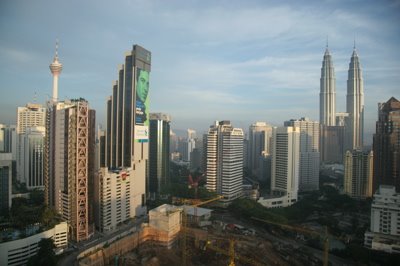
Photograph Copyright (c)2006 by Paul K. Ward.
Sunday, July 30, 2006
WTO Talks Off
Doha Collapses - Good or Bad?
Ah, the anti-globalization people are rejoicing in the streets and the pro-globalization people are either doom-and-gloom about how this will make Africa suffer and hit consumers in the wallet, or hopeful that the talks might be revived like Lazarus (or perhaps like Dracula when the sun sets, from the point of view of anti-globalization activists).
Just as Orwell once said (and I am paraphrasing from "Politics and the English Language") to beware the politician who leans over the podium grasping his lapels and repeating, "Freedom! Freedom! Freedom!", beware trade liberalization people who say that something will hurt Africa and consumers.
I tend to favor globalization, even the hideous version that gets called "globalization' when in fact there are many ways to globalize. However, there are always two key issues I keep in mind when I'm trying to evaluate a proposed WTO initiative or multilateral trade agreement:
1. How will capital be concentrated?
2. How will free trade damage the culture and values of a region or country?
In the first case, we get a clue to who might be pushing behind the scenes to get a decision. Usually, of course, the concentration of capital favors big multi-nationals. That might open up competition, but it doesn't necessarily mean lower prices, nor better quality or choice for consumers. In short, the concentration of capital can just as often work AGAINST the intentions of trade liberalization.
In the second case, the answer can help us understand the non-monetary, apolitical objections of a country. And, after all, WTO cannot (and patently does not) function just as a shill for corporate interests. Some pundits, including Sally at my alma mater LSE, seem to want to restructure the WTO to make it a bit more of such a shill. So, who objects to free trade, for example, in agricultural goods? Those countries and regions where the quality and character of their goods will likely be damaged by free trade. And given that cultural identity is often a complex thing that is rooted to the land, or to history, what's at stake is not just free trade, it's identity. Think of it this way: When you can get products from major multinationals anywhere you go in the world, what does it matter anymore where you actually ARE?
Is the failure of the Doha round a catastrophe? No. If the pushback on agricultural subsidies is a sticking point, the answer is not to restructure the WTO to make sure that the sticking point can be "worked around" (as Sally suggests). The answer is to dig a bit deeper and ask why this is a problem in the first place. Sure, the answer is partially pure protectionism for the sake of softening the blow that globalization makes to certain sectors. But the answer may be deeper than that.
And certainly, if we want to help Africa and lower prices, the WTO has plenty of other options. But, honestly, I don't see the WTO having a legacy of doing anything much more than lowering trade barriers for MNCs (oh, yes, and anyone else, too). Just because WTO now has a larger and more inclusive governance structure, don't be fooled. It's lipstick on a pig. The WTO's lack of success is neither disaster nor success. It's mostly just part of the balancing act between the forces of concentrated capital and the forces of conservative cultures.
Ah, the anti-globalization people are rejoicing in the streets and the pro-globalization people are either doom-and-gloom about how this will make Africa suffer and hit consumers in the wallet, or hopeful that the talks might be revived like Lazarus (or perhaps like Dracula when the sun sets, from the point of view of anti-globalization activists).
Just as Orwell once said (and I am paraphrasing from "Politics and the English Language") to beware the politician who leans over the podium grasping his lapels and repeating, "Freedom! Freedom! Freedom!", beware trade liberalization people who say that something will hurt Africa and consumers.
I tend to favor globalization, even the hideous version that gets called "globalization' when in fact there are many ways to globalize. However, there are always two key issues I keep in mind when I'm trying to evaluate a proposed WTO initiative or multilateral trade agreement:
1. How will capital be concentrated?
2. How will free trade damage the culture and values of a region or country?
In the first case, we get a clue to who might be pushing behind the scenes to get a decision. Usually, of course, the concentration of capital favors big multi-nationals. That might open up competition, but it doesn't necessarily mean lower prices, nor better quality or choice for consumers. In short, the concentration of capital can just as often work AGAINST the intentions of trade liberalization.
In the second case, the answer can help us understand the non-monetary, apolitical objections of a country. And, after all, WTO cannot (and patently does not) function just as a shill for corporate interests. Some pundits, including Sally at my alma mater LSE, seem to want to restructure the WTO to make it a bit more of such a shill. So, who objects to free trade, for example, in agricultural goods? Those countries and regions where the quality and character of their goods will likely be damaged by free trade. And given that cultural identity is often a complex thing that is rooted to the land, or to history, what's at stake is not just free trade, it's identity. Think of it this way: When you can get products from major multinationals anywhere you go in the world, what does it matter anymore where you actually ARE?
Is the failure of the Doha round a catastrophe? No. If the pushback on agricultural subsidies is a sticking point, the answer is not to restructure the WTO to make sure that the sticking point can be "worked around" (as Sally suggests). The answer is to dig a bit deeper and ask why this is a problem in the first place. Sure, the answer is partially pure protectionism for the sake of softening the blow that globalization makes to certain sectors. But the answer may be deeper than that.
And certainly, if we want to help Africa and lower prices, the WTO has plenty of other options. But, honestly, I don't see the WTO having a legacy of doing anything much more than lowering trade barriers for MNCs (oh, yes, and anyone else, too). Just because WTO now has a larger and more inclusive governance structure, don't be fooled. It's lipstick on a pig. The WTO's lack of success is neither disaster nor success. It's mostly just part of the balancing act between the forces of concentrated capital and the forces of conservative cultures.
Monday, July 17, 2006
Global CRM
Upcoming World Affairs Council Talks
As a member of the World Affairs Council, I'm constantly impressed at the timeliness and quality of their speakers -- even when they're shilling books. Hey, one day I'll be doing that. So I don't hold it against them.
This Wednesday, July 19, WAC offers a great chance to hear about the politics of Iran (nuclear, democratic and global). The book he's written, "Confronting Iran: The Failure of American Foreign Policy and the Next Great Conflict in the Middle East", gives historical and speculative future context to what's happening in geopolitics (petropolitics, too) and how national and international policies might make a difference.
For info, go to WAC's site.
As a member of the World Affairs Council, I'm constantly impressed at the timeliness and quality of their speakers -- even when they're shilling books. Hey, one day I'll be doing that. So I don't hold it against them.
This Wednesday, July 19, WAC offers a great chance to hear about the politics of Iran (nuclear, democratic and global). The book he's written, "Confronting Iran: The Failure of American Foreign Policy and the Next Great Conflict in the Middle East", gives historical and speculative future context to what's happening in geopolitics (petropolitics, too) and how national and international policies might make a difference.
For info, go to WAC's site.
Subscribe to:
Posts (Atom)